News analysis ·
Warsh's AI Task Force: A Services Price Shock?
Fed Chair Kevin Warsh asked whether AI could pull services prices down. We explain what was said, what disinflation means and how far it is from policy.
Federal Reserve Chairman Kevin Warsh hosted a conference of his AI task force in San Francisco on Monday to ask a large question: could artificial intelligence do to services prices what the China shock once did to goods prices? CNBC reported on the event. This article separates what the Fed chair actually signalled from what is still only a discussion, and explains why the distinction matters for anyone investing over many years.
What happened at the task force meeting
Warsh framed the moment plainly. "We are at a hinge point in the U.S. economy", he said, according to CNBC. He moderated three out of four sessions and helped pick the speakers, but he mostly let outside experts do the speculating rather than laying out views of his own.
The AI group is one of five task forces Warsh has created on different parts of Fed policymaking. Its official members are venture capitalist Marc Andreessen, Stanford economist Chad Jones, currently on leave at Anthropic, and Xbox CEO Asha Sharma, who did not attend. The chair is deliberately drawing on expertise from outside the central bank.
Not every voice was about prices. Andreessen argued that regulation in fields such as healthcare and education stops technology from replacing workers there, which would slow any rapid displacement of jobs. Former Commerce Secretary Gina Raimondo called the anti-data center measures that voters passed in the Nov. 3 midterms a very troubling sign. CNBC noted that Warsh did not say whether he agreed with her.
The China shock comparison
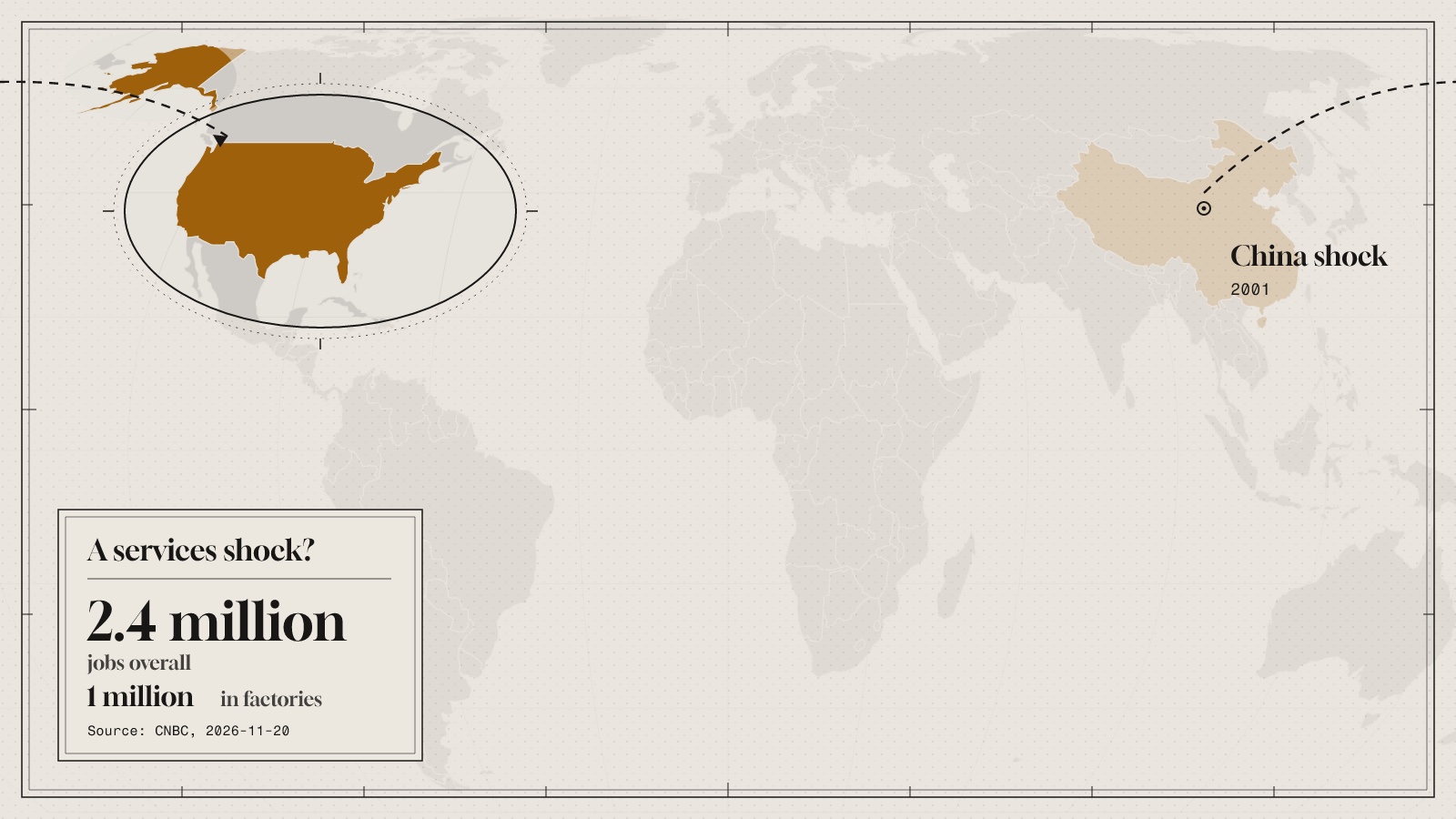
Warsh returned several times to one historical template. After China joined the World Trade Organization in 2001, goods prices in the US fell. The cost was heavy job losses: one estimate cited by CNBC put the toll at 2.4 million jobs overall, 1 million of them in factories.
Warsh suggested AI might do something similar for services, while saying he did not want to hold the idea too tightly. He put it to the panel directly: could AI's reach into services bring medium-term disinflation? The panelists broadly said it was possible.
How it is measured: what disinflation counts
The words matter. Disinflation means prices are still rising, but more slowly. It is not deflation, where the price level actually falls. Services cover a large part of what households spend on, from legal help to administration, so a slower rise in services prices would show up in the inflation measures the Fed watches. Medium term, in central-bank language, usually means a horizon of a few years rather than the next few months.
A question, not a decision
It helps to be precise about what kind of event this was. A task force is an advisory body. It does not set interest rates. The Fed's policy rate is decided by its rate-setting committee at scheduled meetings, using data and staff analysis. What happened on Monday was the chair asking questions in public.
CNBC described the path from here. The three task force members are expected to write a report for Warsh within the next few months. The Fed would then need to debate that report and decide whether, or how, to use it. CNBC also cautioned that many steps separate this discussion from any change in policy.
There is a second, nearer-term thread running the other way. According to CNBC, heavy spending by AI firms is heating the economy, and that is leading the Fed to consider raising rates in December to slow price growth. So AI appears in the Fed's thinking twice: as a source of demand pressure now, and as a possible source of lower services prices later.
Why it matters over years, not days
For a long-term investor, the useful part of this story is the tension between those two time frames. In the short run, AI spending can push inflation and interest rates up. Over a longer run, if AI makes services cheaper to produce, it could push inflation down. CNBC noted that medium-term services disinflation could mean the Fed eventually wants lower rates over the long term.
Interest rates shape the value of almost every asset, from bonds to shares, because they set the return on safe cash and the rate used to discount future income. A shift in the long-run level of rates matters more to a decades-long plan than any single meeting. That is why the chair's questions are worth noting, even though they are not policy.
The China shock comparison also carries a warning. Cheaper goods came with lost jobs. If AI repeats that pattern in services, the gains and the costs may not land on the same people.
Questions to ask about your own plan
None of this calls for action. It is a reason to check whether your plan depends on one view of where rates and inflation are heading. Investing always carries risk, and you can lose money, whichever way rates move.
- Would my plan still work if interest rates stayed higher for longer, and also if they eventually drifted lower?
- How exposed is my income or portfolio to sectors where AI could replace services work?
- Am I reacting to a discussion, or to an actual policy decision?
Sources
- CNBC, 20 Nov 2026
AI-drafted from the official releases cited above and published automatically after checks that every number matches its source and no sentence is copied. No human edited it. It explains what the data means for long-term investors, not what to trade.