Markets & EconomyExplainer
How does the Federal Reserve set interest rates?
The Fed does not set your mortgage or savings rate. It sets a target range for one overnight bank rate. Here is how that works and how it spreads.
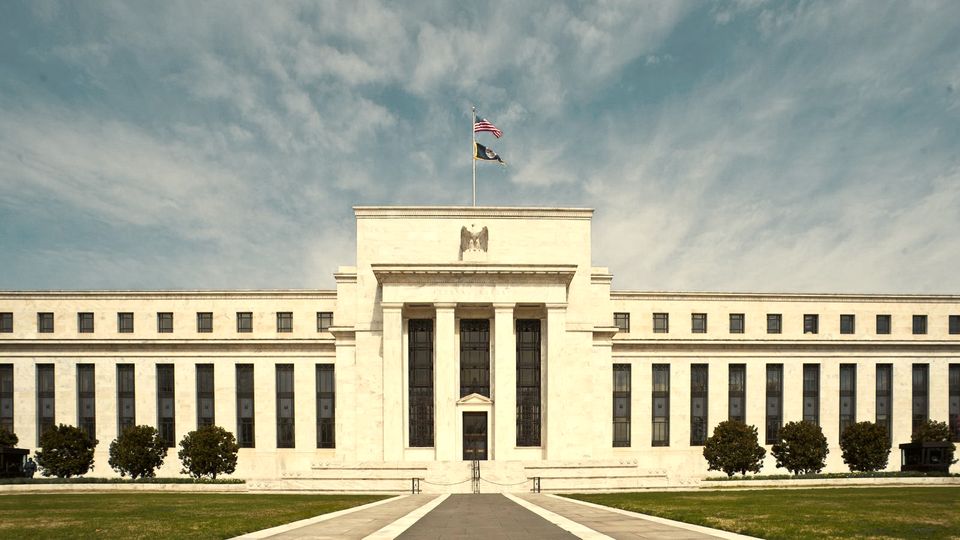
.jpg)
Quick answer
A Federal Reserve committee, the FOMC, votes on a target range for the federal funds rate — the overnight rate banks charge each other. The Fed steers that rate partly by changing the interest it pays banks on reserves. Loan, savings and bond rates then adjust, partly and unevenly.
Key points
- The Fed does not set mortgage, credit card or savings rates directly; it sets a target range for the overnight federal funds rate.
- Twelve voting members of the Federal Open Market Committee make the decision at eight scheduled meetings a year.
- An important lever is the interest rate the Fed pays banks on their reserve balances, which gives the market rate a reason to move toward the target range.
- Short-term rates tend to follow the Fed closely; long-term rates also depend on what markets expect the Fed and the economy to do.
What does the Fed actually decide?#
The Federal Reserve is the central bank of the United States. When people say "the Fed raised rates", they mean one specific decision: a change in the target range for the federal funds rate. The Fed describes the federal funds rate as the interest rate that banks pay to borrow reserve balances overnight[1]. Reserve balances are money that banks keep in their accounts at the Fed.
That is a narrow, wholesale rate. You will never borrow at it. But the Fed calls changing this target its primary means of adjusting the stance of monetary policy[1], and many of the rates you do see are priced off short-term rates like it. Monetary policy simply means the central bank's actions on interest rates and the money supply.
The decision is announced as a range a quarter of a percentage point wide. On September 16, 2026, for example, the committee decided to raise the target range by 1/4 percentage point to 3-3/4 to 4 percent[2]. A quarter of a percentage point is 25 basis points, the unit you will see in most rate headlines.
Who sets the rate, and how often do they meet?#
The decision belongs to the Federal Open Market Committee (FOMC). It has twelve members: the seven members of the Board of Governors, the president of the Federal Reserve Bank of New York, and four of the other eleven Reserve Bank presidents, who serve one-year terms on a rotating basis[3]. All 12 Reserve Bank presidents attend and join the discussion, but only those who are committee members at the time may vote[1].
The FOMC holds eight regularly scheduled meetings per year[3]. The Fed publishes the dates in advance; the last two scheduled meetings of 2026 are October 27-28 and December 8-9[4]. Some meetings also come with a Summary of Economic Projections, in which officials publish their own forecasts[4].
The September 2026 decision in numbers
These are the 2026 settings, shown to make the mechanics concrete. They change at future meetings, so check the latest FOMC statement on the Federal Reserve's website before relying on any level.
What goals guide the decision?#
Congress gave the Fed its goals. The Federal Reserve Act tells it to promote "maximum employment, stable prices, and moderate long-term interest rates"[1]. Because moderate long-term rates tend to follow from the first two, the mandate is commonly called the dual mandate[1].
For prices, the FOMC has put a number on it: inflation of 2 percent per year, measured by the annual change in the price index for personal consumption expenditures (PCE)[1]. For jobs, it does not set a fixed number, because the maximum level of employment depends largely on non-monetary factors that change over time[1]. You can read how the main U.S. price indexes are built in how inflation is measured.
The logic of raising or cutting follows from those goals. In the Fed's own description, monetary policy works by spurring or restraining growth of overall demand for goods and services[1]. When inflation is too high, higher rates aim to cool demand; when the job market weakens, lower rates aim to support it. The September 2026 statement, for instance, said inflation remained elevated and that the increase would support a timelier return to the 2 percent goal[2].
How does the Fed keep the market rate inside its target?#
Announcing a range does not by itself make banks lend at that price. An important tool is the interest on reserve balances (IORB) — the rate it pays banks on money they keep at the Fed. The Board sets this rate, and calls it an important tool for conducting monetary policy[6]. The Fed explains that the FOMC can influence the federal funds rate by changing the rate of interest it pays on reserve balances[1].
The reasoning is simple. A bank is unlikely to lend to another bank at a rate lower than it can earn by leaving the money at the Fed[1]. So when the FOMC moves its target, the Fed typically moves the IORB rate by a matching amount, which gives the market rate a reason to follow[1].
From an FOMC vote to the rate on your loan
| Rate | Level | Role |
|---|---|---|
| Target range for federal funds | 3.75% – 4.00% | The policy decision itself |
| Interest on reserve balances (IORB) | 3.90% | Important tool for steering the market rate |
| Overnight reverse repo offering rate | 3.75% | Set at the bottom of the range |
| Primary credit (discount window) rate | 4.0% | Set at the top of the range |
Levels from the Federal Reserve's FOMC statement and implementation note of September 16, 2026[5]. The 'Role' column summarizes how the rates sit relative to the range.
Then the Fed checks the result. The New York Fed publishes the effective federal funds rate, calculated as a volume-weighted median of actual overnight federal funds trades, each business morning[7]. If that number sits inside the target range, the system is working as intended.
How does a Fed decision reach mortgages, savings and stocks?#
The link is strongest for short-term money. The Fed notes that rates on commercial paper and U.S. Treasury bills typically move closely with the federal funds rate[1]. Rates on variable-rate loans and savings accounts may follow, but each bank decides its own pricing and timing.
Worked example
Worked example: what 25 basis points means on a $10,000 balance
Suppose a variable-rate loan of $10,000 charges 7.00% a year and the lender passes on each quarter-point change in full. These rates are illustrative, not quotes. Each 0.25-point step changes the yearly interest by $25. On the other side, $5,000 in a savings account earns $175 a year at 3.50% and $187.50 at 3.75% — if the bank raises its rate at all.
| Loan rate | Interest per year | Interest per month |
|---|---|---|
| 7.00% yearly rate | $700.00 | $58.33 |
| 7.25% yearly rate | $725.00 | $60.42 |
| 7.50% yearly rate | $750.00 | $62.50 |
Figures computed in code from the stated inputs; rounded to the nearest cent or tenth.
Long-term rates are different. The Fed explains that rates on longer-term loans depend on expectations of how monetary policy and the economy will evolve over the life of the loan, not just on today's federal funds rate[1]. That is why a 30-year mortgage rate can rise even in a month when the Fed cuts, or fall before the Fed moves. The gap between short and long rates is what the yield curve shows.
Rates also reach investments. According to the Fed, changes in interest rates tend to affect stock prices by changing how attractive stocks look compared with other ways of holding wealth[1]. Bonds react even more directly: see why bond prices fall when rates rise. And lower mortgage rates make buying a house more affordable and encourage refinancing[1], which is one way policy reaches spending.
What should a beginner watch after a Fed meeting?#
Read the statement, not just the headline
The FOMC statement is short. Note the new range and the reasons given, especially what it says about inflation and jobs.
Check what changes for you
Variable-rate debt and savings rates are where a change can show up. The rate on a fixed-rate loan you already have stays as agreed.
Separate short and long rates
A move in the federal funds rate does not fix the direction of mortgage or long bond yields, which depend on expectations.
Avoid trading on the news
Prices can move sharply around announcements. A long-term plan should not depend on guessing one meeting.
What mistakes do beginners make?#
Thinking the Fed sets your mortgage rate
The Fed sets a target for an overnight bank rate. Mortgage rates are set by lenders and track longer-term market rates, which can move the other way.
Confusing percentage points with percent
A move from 3.75% to 4.00% is a rise of 0.25 percentage point, or 25 basis points — not a 0.25% increase in the rate itself.
Treating one meeting as a forecast for the year
The FOMC decides meeting by meeting. Reading a single move as the start of a long trend can push you into rushed portfolio changes.
Ignoring inflation when comparing rates
A savings rate that rises with Fed hikes can still lose buying power if prices rise faster. Compare rates with inflation, not just with last year's rate.
What else do beginners ask?#
Does the Fed set interest rates for everyone?
No. It sets a target range for the federal funds rate and the rate it pays on bank reserves[6]. Banks and markets set the rates on loans, deposits and bonds, which tend to move with it, especially at short maturities.
How many times a year does the Fed change rates?
The FOMC has eight scheduled meetings a year[3]. At each one it can raise, cut or leave the target range unchanged.
What is the difference between the federal funds rate and the discount rate?
The federal funds rate is a market rate between banks. The discount (primary credit) rate is what the Fed charges banks that borrow directly from it; after the September 2026 decision it was 4.0%[5].
Why does the Fed target PCE inflation rather than CPI?
The FOMC states its 2 percent goal in terms of the PCE price index[1]. The CPI is a separate index from a different agency; both are explained in our note on how inflation is measured.
What is the bottom line?#
The Fed controls one short, wholesale interest rate, and an important way it does so is by changing what it pays banks on reserves. From there, effects spread outward: quickly to short-term rates, more loosely to long-term rates, stock prices and spending. For a beginner, the useful habit is to ask what a decision changes for your own debts and savings — and to leave predictions about the next meeting to others.
Sources
Numbers in brackets in the text point here. Grade A = primary source (regulator, statistics agency, law or official document).
- 1
- 2
- 3
- 4
- 5
- 6
- 7