News analysis ·
Euro area food inflation at 1.3%: what the ECB sees next
An ECB staff blog says euro area food inflation fell to 1.1% in August but may rise to 3.4% by Q3 2027. How the food index is built and why it matters.
Food inflation in the euro area has cooled sharply this year, even as headline inflation climbed. A blog post published by the ECB on 20 October 2026 argues the calm is temporary and that food prices are set to pick up again through 2027. This article looks at what the food number measures, why it fell, and how a long-term investor can read it.
The release: low food inflation inside a higher headline
The post was written by four ECB staff economists: Christiane Nickel, Elena Bobeica, Friderike Kuik and Gerrit Koester. It sets two trends side by side. Headline inflation in the euro area stood at 1.7% in January 2026 and had reached 3.8% by September. According to the ECB authors, most of that rise came from energy commodity prices, which jumped after the Middle East conflict began. Consumer energy inflation reached 18.9% in September.
Food went the other way. Food inflation was 2.6% in January and slid to 1.1% in August, the weakest reading since mid-2021. September brought a small rise, to 1.3%. The authors credit earlier tailwinds: good European harvests last year, cheaper world prices for coffee, tea, cocoa and sugar, and lower farm-gate prices.
How it is measured: rates, levels and the two halves of the basket
The euro area tracks consumer prices with the Harmonised Index of Consumer Prices, or HICP. Food is one component of that basket. The inflation rate is the change in prices compared with a year earlier. So a lower food inflation rate does not mean food got cheaper. As the authors stress, it means prices are rising less quickly, while the overall level stays higher.
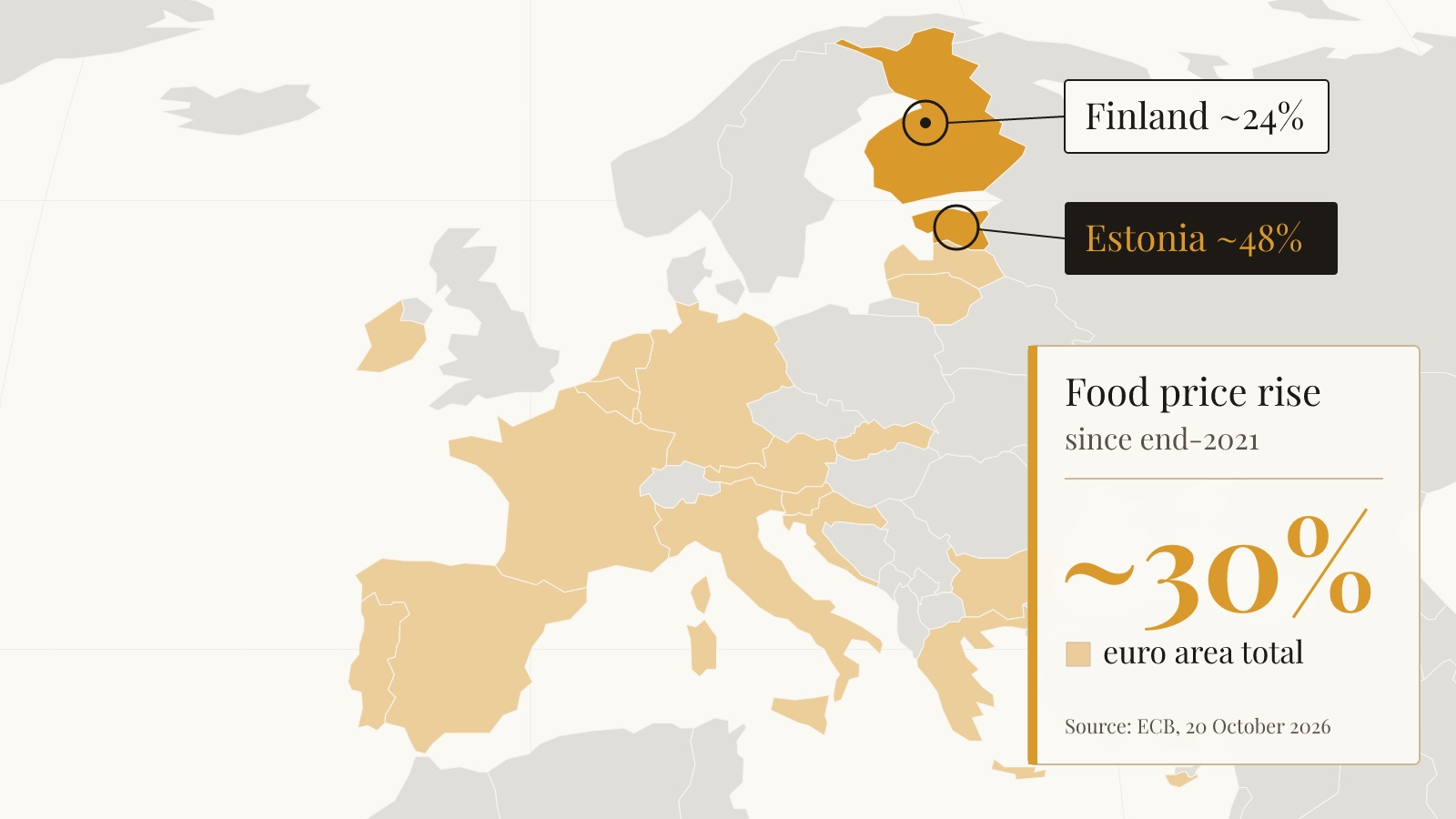
The level is worth keeping in view. Since the end of 2021, euro area food prices have risen around 30% in total. Country figures spread widely: Estonia sits near the top at around 48%, Finland near the bottom at around 24%. A single euro area figure hides that spread.
The food index also has two halves that behave differently. Unprocessed food, such as vegetables, reacts quickly to weather. Processed food, the bigger share of the basket, moves more slowly because it passes through factories and supply chains. In September the whole uptick came from unprocessed food, which rose to 4%, driven by weather-sensitive vegetables. Processed food eased to 0.4%. Reading the two halves separately tells you whether a move is a fast weather effect or a slower cost trend.
Why the ECB staff expect food prices to turn up
The authors see two pressures building upstream. The first is energy. Energy costs feed into food slowly, through transport, fertiliser, packaging and processing, and the blog says these effects can take several months to reach consumer prices. Fertiliser producer prices have surged since a blockade of the Strait of Hormuz, reflecting supply disruption as well as costlier energy, unlike in 2022. Later-stage food producer prices had not yet risen as of August, because they tend to lag input costs.
The second is weather. Heat and drought across much of Europe in 2026 hurt crop prospects. ECB staff estimate that this could add 0.3-0.8 percentage points to euro area food inflation over the coming year.
Put together, the September 2026 ECB staff projections see food inflation climbing to 3.4% by Q3 2027 and only declining after that. The authors expect this peak to be roughly one-fifth of the one that followed Russia's invasion of Ukraine. Their reasons: the energy shock is smaller, it is driven more by oil, and demand is weaker than in 2022. In the authors' words, "It is too early to assume that food inflation has lost its bite."
Why it matters over years, not days
This is the part a long-term investor can use. The blog is a reminder that inflation is a sum of parts with different clocks. Energy can move headline inflation within weeks. Food can follow months later, through processed goods. A falling food number today can therefore sit alongside rising pipeline pressure, which is visible first in producer prices.
It also matters for policy. The authors argue that food carries weight for monetary policy because people buy it often, so it strongly shapes how inflation is perceived. In a Eurobarometer poll published on 22 September 2026, reasonable food prices were named a top EU priority by 55% of Europeans.
Two caveats apply. The models disagree on timing: machine-learning models that include weather point to a later reaction, while other short-term models show a steeper rise. All of them, though, show food inflation increasing over 2027. And the views in the post are the authors' own, not official ECB positions. It is analysis, not a policy decision.
Questions to ask about your own plan
A projection is not a reason to act on its own. It is a prompt to check how your plan treats inflation.
- Does my plan judge returns after inflation, rather than in nominal terms only?
- When I read an inflation release, do I look at its components and producer prices, or only the headline?
- If inflation stays above recent levels for longer, which parts of my portfolio would I expect to hold up, and why?
Sources
- ECB, 20 Oct 2026
AI-drafted from the official releases cited above and published automatically after checks that every number matches its source and no sentence is copied. No human edited it. It explains what the data means for long-term investors, not what to trade.