News analysis ·
CNBC Fed Survey: 76% see a December rate hike
CNBC's Fed Survey finds 93% expect a pause this week and 76% a December hike. We explain what a forecaster survey measures and how to read it.
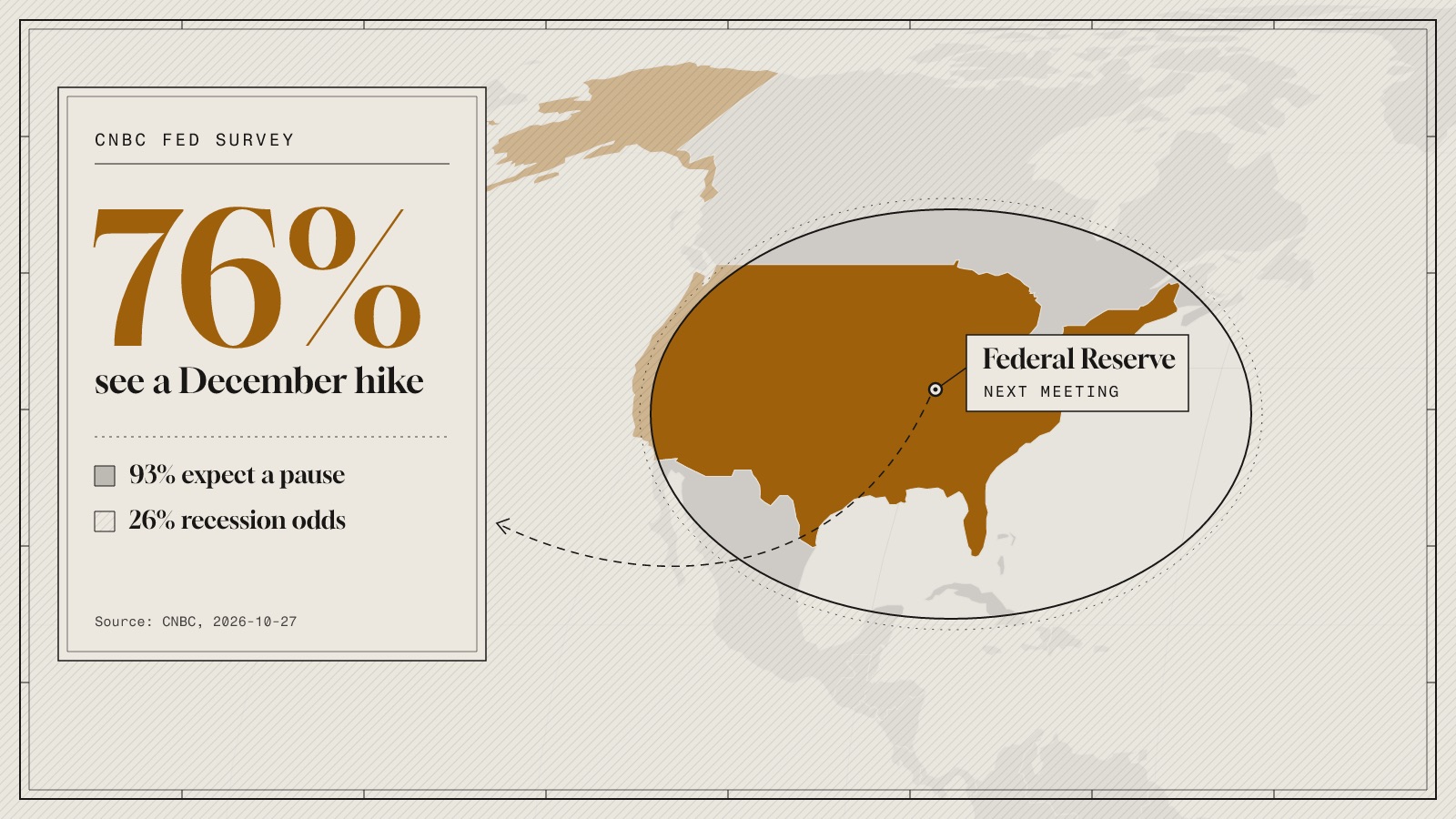
Most forecasters expect the Federal Reserve to leave interest rates unchanged at this week's meeting, but they see a hike coming in December. That is the main finding of the latest CNBC Fed Survey. This article looks at what the survey actually measures, where the forecasters disagree, and how a long-term investor can read a poll of expectations without treating it as a forecast of their own future.
What the survey found
CNBC asked 30 fund managers, strategists and economists for their views ahead of the Fed meeting held this week. According to CNBC, 93% of them expect a pause, meaning no change to the Fed's policy rate. The bigger signal is what comes after: 76% expect the Fed to raise rates at its next meeting, in December. More than half also expect hikes next year, averaging roughly two increases.
The group is not unanimous. 30% said the Fed ought to raise rates right now, and respondents expect at least two Fed voters to dissent from a decision to hold. A dissent is a formal vote against the majority.
The reason behind the hawkish lean is inflation. Consumer Price Index inflation was running at 3.7% in September. Respondents see it at 3.6% by the end of the year and 2.6% next year. 70% of them view inflation as a wider problem than higher energy prices alone.
How it is measured
A survey like this does not measure the economy. It measures opinions about the economy and about the Fed. Each respondent gives a view, and the published figures are shares of the group or averages of their numbers. A 76% reading means that share of the people asked expect a December hike. It does not mean a 76% chance that a hike will happen.
That difference matters. A small panel can lean the same way and still be wrong together, because its members often read the same data. The survey also moves between editions. The panel's estimate of the odds of a US recession within a year fell to 26%, against 29% last time. The change tells you how the mood shifted, not what the economy will do.
It helps to keep two terms apart. Growth potential is the pace an economy can sustain without pushing inflation up. Respondents expect GDP growth of 2.4% this year and 2.2% in 2027, versus 2.05% in 2025, and they see both forecasts above potential. Growth above potential is one reason a central bank may lean toward higher rates.
Where the forecasters disagree
The split is about how hard the Fed must push. 40% say the Fed has to slow growth below potential to fix inflation. 27% say no slowdown is needed, and 23% say only a partial slowdown is needed.
Richard Bernstein of Janus Henderson Investors called the Fed's reluctance to hike unfathomable, pointing to nominal GDP of 6-8% and leading inflation indicators he described as warm to hot. Mark Zandi of Moody's Analytics took the other side. He cited the Iran war, falling real wages, rising rates and a shaky stock market, and argued against more hikes. "Inflation is high, but there's little sign it is becoming entrenched," Zandi said.
Entrenched inflation is the key idea in that debate. It means people and firms start to expect high inflation and build it into wages and prices, which makes it harder to bring down.
Why it matters over years, not days
For a long-term investor, the useful part of the survey is not the December call. It is the picture of where rates may sit for longer. On average, respondents see the 10-year Treasury yield staying above 5% this year and easing to 4.8% in 2027. The 10-year yield feeds into mortgage rates, corporate borrowing costs and the discount rate used to value future profits.
The survey also asked why yields are high. On the supply side, 50% blamed government borrowing and 13% blamed debt raised for the AI buildout, while a third said both mattered equally. Supply here means the amount of new bonds that buyers must absorb. More supply can push yields up even when the Fed does nothing.
Respondents named a longer Iran war and an AI bubble bursting as the biggest risks. 63% see some market risk from legal fights that could prolong uncertainty over control of Congress after next week's election, and 41% expect larger deficits. Unemployment is projected at 4.2% for the rest of this year, rising to 4.4% in 2027. These are the inputs that shape the rate path over several years, and each of them can change.
Questions to ask about your own plan
A survey of expectations is a snapshot of opinion, and forecasters are often wrong. Investing carries risk, and you can lose money, whatever rates do. These questions can help turn it into something useful for your own planning.
- Would my plan still work if rates stayed higher for longer than most forecasters expect?
- How much of my portfolio depends on borrowing costs falling, and do I know why?
- Am I reacting to a survey headline, or to a change in my own goals and time horizon?
Sources
- CNBC, 27 Oct 2026
AI-drafted from the official releases cited above and published automatically after checks that every number matches its source and no sentence is copied. No human edited it. It explains what the data means for long-term investors, not what to trade.