News analysis ·
Euro Area GDP Grew 0.4% in the Third Quarter
Eurostat reported euro area GDP grew 0.4% in the third quarter. We examine how regional divergence shapes long-term asset allocation.
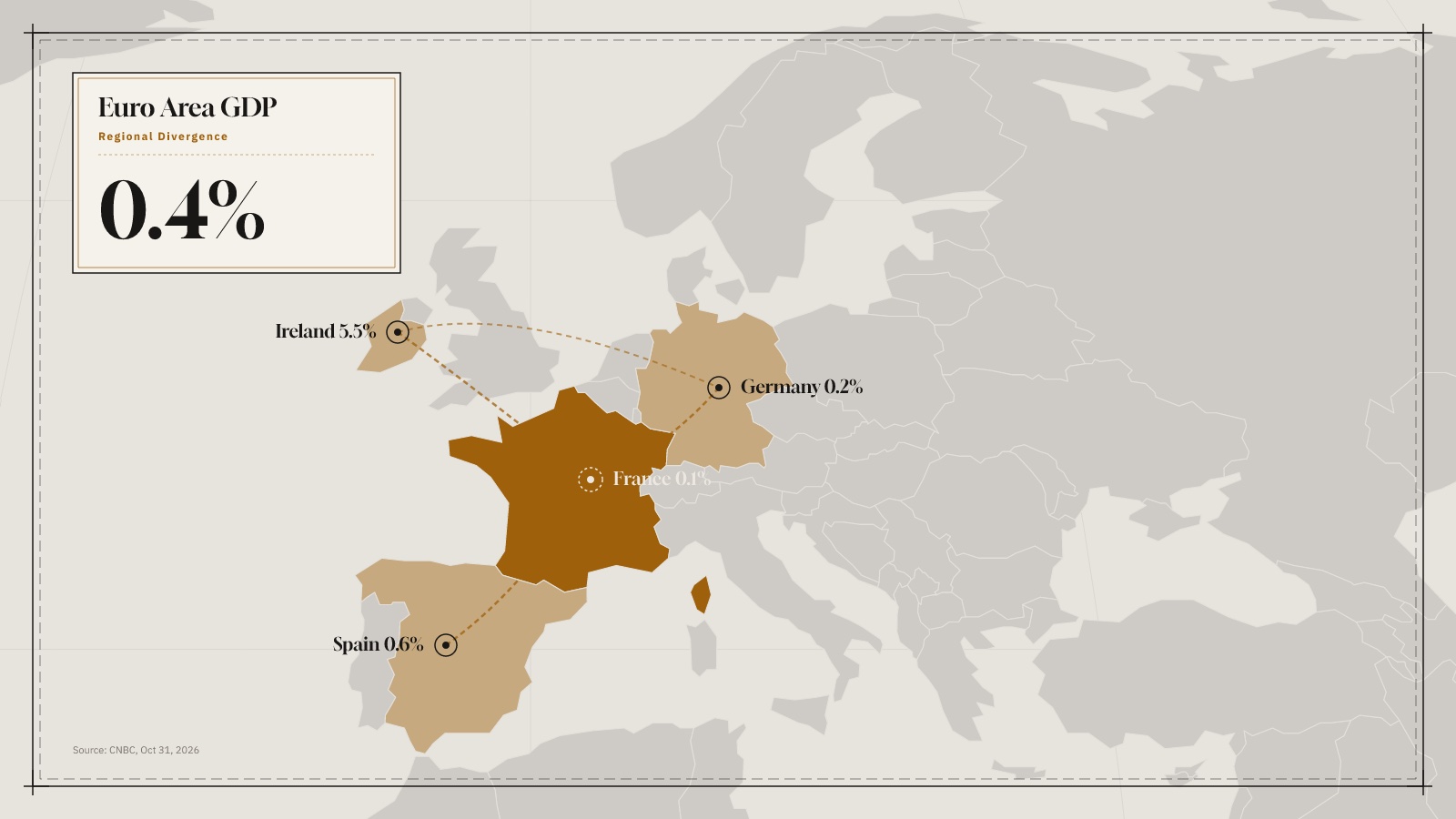
The statistical office of the European Union, Eurostat, reported that third-quarter economic output across the 21-nation euro area expanded by 0.4%. While the aggregate figure came in ahead of expectations, national performances across member states showed sharp divergence, ranging from outright contraction in France to stronger momentum in Spain. For long-term investors, examining the underlying components of regional growth provides essential context on productivity, fiscal stability, and monetary conditions.
The Third-Quarter Numbers and National Divergence
According to CNBC, the 0.4% expansion reported for the third quarter marked a slowdown from the 0.6% rebound recorded in the second quarter, following economic stagnation in the first quarter of the year. The preliminary third-quarter gross domestic product print exceeded the 0.2% expansion projected by economists in a Reuters survey. Addressing the aggregate outcome, Joe Nellis, who oversees economic research at MHA, observed that the currency bloc was "showing unexpected resilience against a backdrop of considerable economic and geopolitical uncertainty" in comments reported by CNBC.
Beneath the headline aggregate, economic performance fractured along national borders. Germany, the largest economy in the currency bloc, grew by 0.2% during the third quarter. France, the second-largest economy, recorded an unexpected gross domestic product contraction of 0.1% between July and September. Italy, the third-largest economy in the euro area, recorded flat economic growth over the same three-month span. In contrast, Spain posted a 0.6% output expansion, outpacing the regional average thanks to domestic demand, productivity, tourism, and stronger public finances. Ireland registered gross domestic product growth of 5.5%, though headline figures for the Irish economy remain volatile because of multinational corporate activity.
How Gross Domestic Product Is Measured
Gross domestic product, commonly abbreviated as GDP, measures the total monetary value of all finished goods and services produced within a geographic border during a specific timeframe. To allow meaningful comparisons across quarters, statistical agencies adjust these figures for seasonality, removing predictable calendar patterns such as summer holidays or winter heating demand. The figures released at this stage represent a preliminary estimate, meaning they rely on incomplete source data and survey samples that Eurostat and national statistics offices will revise as tax filings and comprehensive corporate reports arrive.
Measuring an economic bloc composed of 21 sovereign nations introduces unique aggregation challenges. Headline growth weights national results by economic size, which can obscure critical shifts in individual member states. Furthermore, corporate structures can distort headline production numbers. In open jurisdictions such as Ireland, multinational balance-sheet transactions, intellectual property transfers, and contract manufacturing often inflate output metrics without reflecting domestic employment or broader consumption trends. Understanding these measurement nuances keeps investors from treating a single headline percentage as a uniform reading of economic vitality across the entire currency area.
Structural Headwinds and the Central Bank Backdrop
The growth report arrived alongside policy decisions from Frankfurt. As reported by CNBC, the European Central Bank left interest rates unchanged on Thursday, noting that energy price shocks have not triggered wider second-round effects. Second-round effects refer to the process where initial supply-driven price increases lead to broader wage hikes and permanent price resets across the economy. Even so, central bank policymakers cautioned that downside risks facing regional economic growth have multiplied.
At the same time, national finances create uneven pressures across the currency union. In France, public finances face elevated borrowing costs alongside political disputes over reducing large budget deficits and heavy government debt. Beyond near-term fiscal debates, economists highlighted lingering structural vulnerabilities across the bloc. These enduring challenges include sluggish productivity, low investment, demographic headwinds from aging populations, and weakened industrial competitiveness. When individual member states struggle with high debt loads and weak competitiveness, their capacity to finance public investments or withstand economic slowdowns diminishes.
Why Diverging Growth Matters Over Years, Not Days
Short-term traders often focus on whether a headline GDP release beats or misses quarterly consensus estimates. For long-term investors, the value of the release lies in revealing the underlying trajectory of corporate earnings potential, sovereign credit risk, and real capital returns. A monetary union operates with a single interest rate set by the central bank, but member states experience different inflation rates, fiscal realities, and labor productivity levels. When national economies diverge, a unified monetary policy cannot fit every member state equally well.
Persistent growth gaps influence asset allocation over a multi-year horizon. Stronger productivity and sounder public finances, as seen in Spain, create an environment where businesses can reinvest retained earnings efficiently. Conversely, jurisdictions facing stagnant growth, heavy debt, and political impasses may rely on fiscal restraint or elevated taxation, dampening long-term corporate profitability. Rather than viewing the euro area as a single monolithic market, long-term allocators evaluate how structural competitiveness differences affect the risk-adjusted returns of regional equity sectors and sovereign bond markets.
Questions to Ask About Your Own Plan
Allocating capital across international markets requires assessing structural resilience rather than headline momentum alone. Consider these questions when evaluating regional exposure:
- Does your international portfolio treat the euro area as a uniform bloc, or does it account for structural differences between member economies?
- How would your bond holdings react if diverging national fiscal conditions lead to widening differences in sovereign borrowing costs?
- Are your long-term return assumptions based on short-term aggregate growth surprises or on structural factors such as productivity and demographic trends?
Sources
- CNBC, 30 Oct 2026
AI-drafted from the official releases cited above and published automatically after checks that every number matches its source and no sentence is copied. No human edited it. It explains what the data means for long-term investors, not what to trade.