News analysis ·
China's $1.04 Trillion Trade Surplus: Reading the Data
China's goods surplus reached $1.04 trillion by October. We explain what the customs figures count and why the export-consumption gap matters.
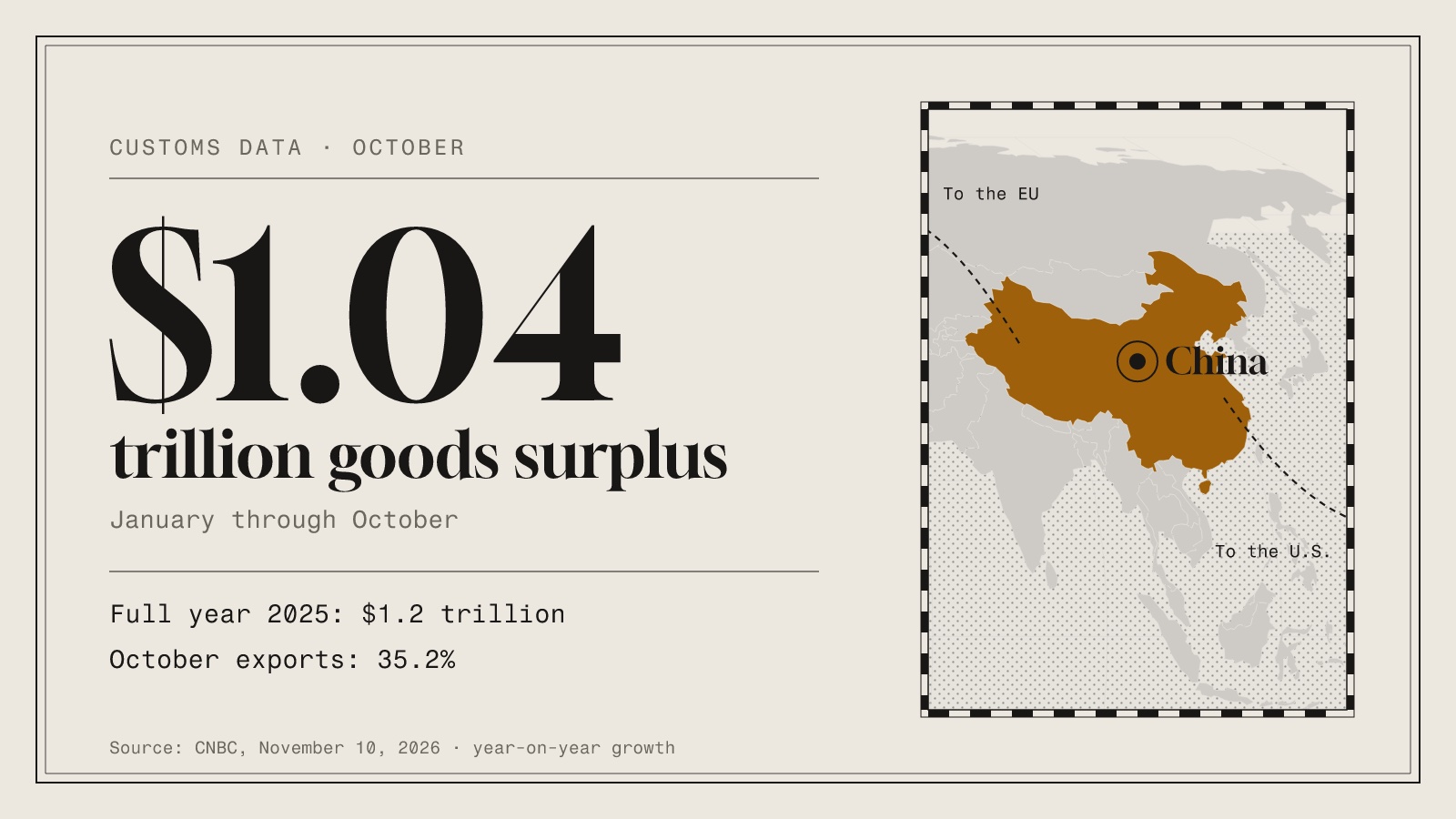
China's goods surplus for January through October reached $1.04 trillion, according to official customs figures published on Tuesday and reported by CNBC. Exports and imports both grew fast in October, but imports grew faster. This article looks at what the release measures, what changed from the month before, and why the gap between strong trade and weak household spending is worth watching over years.
What the October customs release showed
The headline is the running total. By the end of October, China had sold $1.04 trillion more in goods to the rest of the world than it bought. For comparison, the full-year 2025 surplus was a record $1.2 trillion, the first year the figure went above the $1 trillion mark.
Exports in October were 35.2% higher than a year earlier. That beat the 33.5% gain economists in a Reuters poll had expected, though it was slightly slower than the 36.3% growth recorded in September. Imports rose 41.6%, the fastest pace since May 2021, and far above the 32% forecast by analysts polled by Reuters.
Because imports jumped, growth of the surplus in October eased to a six-month low and came in below market estimates. Even so, Lynn Song, who leads Greater China economics at ING Bank, said: "China remains well on pace for a new record high for the trade surplus by year-end despite a miss in October".
How it is measured
A trade surplus is simply exports minus imports of goods over a period. Customs data count physical shipments crossing the border and record them by value. Services, such as tourism or software licences, are not part of this figure.
The growth rates in the release compare a month with the same month a year earlier. That removes normal seasonal swings, but it also means the result depends on how strong or weak the earlier month was. Analysts call this a base effect. A different lens is month-on-month change after seasonal adjustment. Using that method, Nguyen Hoang Nam of Capital Economics estimated that exports fell 2% in October, and said momentum seems to have cooled. Two honest readings of the same release can therefore point in different directions.
Value also matters. When imports are measured in money terms, a rise can come from higher prices as well as larger volumes. CNBC, working from the official numbers, calculated that high-tech imports rose 72% by value in October from a year ago, while crude oil imports grew about 41%, LNG about 50% and coal about 60%.
What is driving the numbers
Two forces stand out in the reporting. On the export side, CNBC tied the strength to worldwide demand for Chinese-built AI hardware. On the import side, Tianchen Xu of the Economist Intelligence Unit said the rise was led by technology products, energy supplies and minerals like copper.
Two trade partners stand out. Shipments to the U.S. rose 32.9% by value and imports from the U.S. nearly 35%, leaving a bilateral surplus of $32.7 billion. With the EU, China's exports grew 24.4% while imports fell more than 4%, lifting that surplus to $33.4 billion.
Why it matters over years, not days
The more lasting story is balance. Retail sales rose a modest 1.1% in September, a sign that households are still cautious. Strong exports have let Beijing stay with moderate stimulus while aiming for its annual growth goal of 4.5%-5%. Trading partners and the International Monetary Fund have urged China to lean less on exports and more on domestic consumption.
For a long-term investor, this matters because growth that rests on one channel is more exposed to shocks in that channel. If the global AI build-out slows, the export engine could lose speed. Yuanliu Hu of Citi Research projected that in 2027 exports may grow only 8% as base effects fade and AI investment moderates. Policy is a second risk: the reporting names EU trade friction and a U.S.-China truce, extended in September, that runs out in January. Xi Jinping and Donald Trump are scheduled to meet at the APEC summit in Shenzhen next week, their third meeting this year.
None of this says what any market will do next. It does show why a single monthly surplus figure is less useful than the trend in what China buys, what it sells, and how much its own households spend. Reading those three together, release after release, gives a steadier picture than any one headline.
Questions to ask about your own plan
Large trade imbalances can shape the companies, sectors and regions that sit inside broad funds. Investments can lose value, and a trade shock can hurt funds as well as help them. A few questions can help you think about your exposure calmly.
- How much of my portfolio depends, directly or through funds, on a single theme such as AI hardware demand?
- Do I know which regions my funds hold, and would a trade dispute between large economies change how comfortable I feel with that mix?
- When I read a monthly trade headline, do I check whether it is a year-on-year or a month-on-month figure before drawing any conclusion?
Sources
- CNBC, 10 Nov 2026
AI-drafted from the official releases cited above and published automatically after checks that every number matches its source and no sentence is copied. No human edited it. It explains what the data means for long-term investors, not what to trade.